
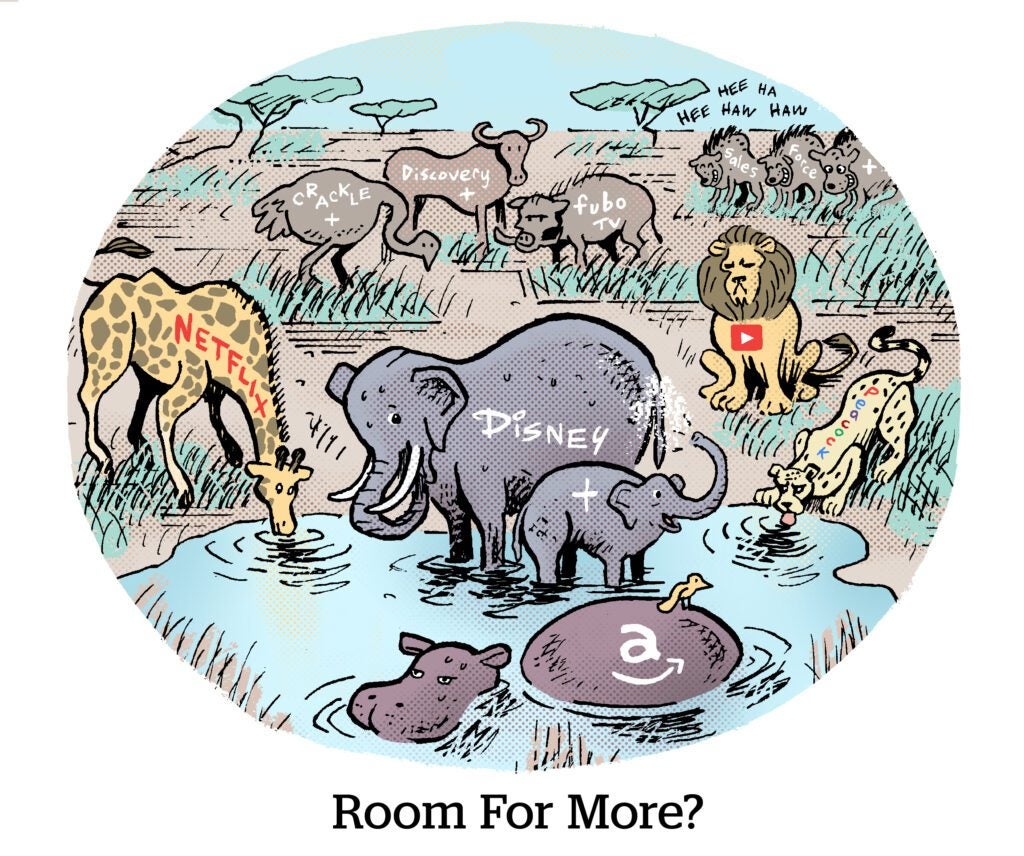
Prime Time 2.0
Big TV networks and studios are finally shifting toward programmatic advertising – even for their linear TV spots.
And this shift is attracting a new wave of advertisers and transforming what a typical TV ad break looks and feels like.
For example, as Digiday reports, Comcast is starting to see net-new ad revenue growth from first-time TV advertisers. “The people coming in the door are small performance advertisers, but they’ve been doing social ads forever,” says Travis Flood, Comcast Advertising’s director of insights. “They don’t have a TV ad.”

What does this trend mean for viewers? Well, all of a sudden, they’re being presented with TV ads that are not only shoppable but also appear more targeted.
As Comcast and Disney, not to mention YouTube and Amazon, embrace programmatic targeting, TV is becoming a more performance-based and conversion-oriented channel. Which doesn’t just affect campaign attribution reports but the experience of people watching television.
Subscription Meta-stasis
To pay or not to pay?
That’s the question Meta will soon pose to its more than 3 billion daily active users.
On Monday, Meta announced plans for a premium subscription version of Instagram, Facebook and WhatsApp. The company will test a variety of subscription features and bundles with each subscription tier carrying its own “exclusive features,” TechCrunch reports.
The Instagram subscription, for instance, will include a tool so users can see who doesn’t follow them back and an option to view stories privately, per a post on X from “reverse engineer” Alessandro Paluzzi, who found and leaked the unreleased features.
Any special features for the Facebook and WhatsApp subscriptions have not yet been revealed.
Additionally, Meta plans to scale Manus, the AI startup it bought in December, as part of its subscription strategy, integrating the tech across its products while also keeping it available as a separate service. On top of that, Meta will test subscription tiers for individual AI tools, including advanced features in its Vibes video generator.
The question is whether people will be willing to pay yet another monthly fee to access these new features. Guess it depends how badly someone wants to watch their ex’s Instagram Story undetected.
Scouting Out Search
Yahoo has launched yet another AI search product into an already overly saturated space.
The product, called Scout, is designed as a guide to help users quickly find relevant information about whatever interests them. Scout is available in beta as a feature within the Yahoo Search mobile app and on the web.
Yahoo’s move into AI search is logical given its existing reach across search, email and content verticals, including news and finance. But Yahoo will be hard-pressed to compete with Google in the AI search arena (let alone plain old search).
Apparently, Yahoo hopes to carve out a competitive advantage in shopping. Scout launched with affiliate links in search results related to shopping, along with an ad unit that appears below some searches.
The Verge reports that Scout’s links are more visually prominent – they show a preview when users hover – and therefore might encourage more clicks than other AI-based search engines, such as Gemini, Perplexity or Claude.
If Yahoo can demonstrate higher click-through rates than Gemini despite having smaller scale, more advertisers will buy in. Or so the thinking goes.
In a world where marketers face ever-intensifying pressure to justify each media dollar, it’s certainly possible.
But Wait! There’s More!
Cloudflare’s acquisition of AI startup Human Native signals a new content economy for publishers. [Digiday]
Pinterest will cut up to 700 jobs, roughly 15% of its workforce. [WSJ]
Americans have the right to be anonymous online – including when they document real-world ICE activity or even just make fun of ICE on social media. [Tech Policy Press]
On a related note, Meta has blocked users from sharing links to the ICE list, a website that purports to contain the names of thousands of Department of Homeland Security employees. [Wired]
Apple’s and Google’s app stores host dozens of “nudify” apps that create nonconsensual nude images of real people. [CNBC]
Why aren’t internet ads subject to consumer protection laws about false advertising claims, like the ones that exist in Australia? [The Guardian]
Amazon says goodbye to its brick-and-mortar retail stores. [Reuters]
You’re Hired!
Vibhor Kapoor is the next CEO of NextRoll. [release]
PubMatic names Joseph Dressler as SVP of advertiser solutions for brands, and Bill McLaughlin as SVP of advertiser solutions for agencies. [release]
StackAdapt appoints Katy Friday, The Trade Desk’s former SVP of business development, to its revenue leadership team. [release]
Thanks for reading AdExchanger’s Daily News Roundup. Want it by email? Sign up here.