


Most of what’s sold as “contextual” today still runs on the same keyword logic we used a decade ago. The industry didn’t reinvent contextual targeting; it simply replaced one keyword with a cluster.
Keywords were once the best we had. Now, keyword-based targeting is fundamentally inaccurate – and it’s time we admit it. In English-speaking markets, its flaws are easy to miss. Take it globally across multilingual Europe, Africa, Asia or the Middle East, and it breaks almost instantly.
A phrase that feels empowering in English might sound sarcastic in Indonesian, for example. Humor doesn’t always translate, and nuance disappears.
Ironically, however, it’s artificial intelligence, not humans, making digital ads feel more human.

The global blind spot
The main issue with today’s contextual advertising is its focus on a small part of the internet – mostly the English-speaking Western world. That approach ignores how meaning shifts across languages, cultures and even emotions.
In many emerging markets, context isn’t just linguistic; it’s cultural and situational. Yet most contextual systems still rely on static keyword lists and fixed audience categories. They can’t recognize these nuances. Somehow, we’re still using tools meant for one audience to engage with a world that speaks many languages and thinks in countless ways.
From keywords to comprehension
This is where artificial intelligence changes everything.
Contextual advertising solutions built with AI must solve four long-standing limitations that have held back contextual targeting.

1. Understand meaning, not just words. Contextual advertising solutions need to read an entire page, including its structure, tone and sentiment, to understand intent the way a human would.
2. Go beyond prepackaged audiences. While most contextual solutions offer fixed categories, effective contextual advertising solutions let advertisers create programmable real-time audiences that reflect brand mood, values and emotional tone.
3. Be multilingual and culturally adaptive. The platform must understand nearly all world languages, enabling teams to run contextually relevant campaigns in Romanian or Swahili without losing local touch.
4. Be transparent and auditable. Every ad placement should come with an explanation: why it matched (or didn’t) and how it aligns with the brand’s strategy. That clarity will let advertisers refine context in real time instead of guessing what the algorithm saw.
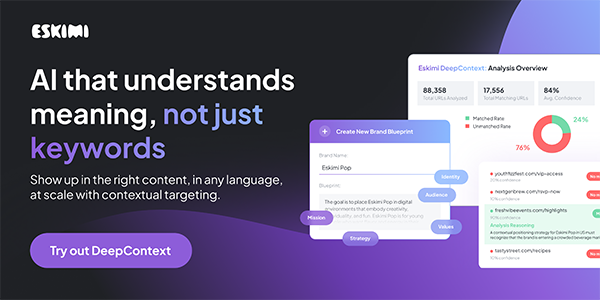
Eskimi’s DeepContext tool has all four of these capabilities. It starts with a Brand Blueprint. This is a custom framework that outlines tone, sensitivities and desired associations. The Relevance Engine then scans live web content, continuously learning which environments best align with that blueprint. This custom approach can be activated on any DSP.
DeepContext also offers ready-to-activate thematic (e.g., Winter Olympics) audience sets. They are available through major SSPs, such as Index Exchange, PubMatic and Equativ. It’s a quicker way to use contextual intelligence without building from scratch.
A more human intelligence
For years, digital advertising has tried to decode context through keywords and assumptions. AI gives us a chance to start over and build understanding instead of approximation.
By grasping meaning, tone and local context, contextual advertising powered by AI allows brands to finally speak with people, not just at them. When we move from data points to meaning, we don’t just improve performance; we make digital communication feel human again.