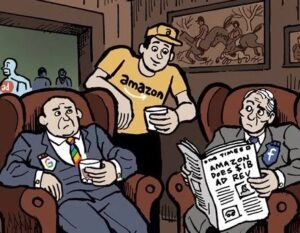

For the past three decades, most of digital advertising has revolved around one obsession: performance. Marketers leaned on channels that could prove conversions: search ads, programmatic retargeting and affiliate links. A purchase trackable to a click was gold. Multi-touch attribution (MTA) models thrived.
Conversely, brand-building was often dismissed as harder to justify next to the cold precision of ROAS spreadsheets.
That era is ending. AI shopping agents are breaking the traditional attribution loop and changing which signals marketers use to prove performance. Going forward, marketers must ensure that AI is aware of their brand and track how that awareness influences ecommerce outcomes.

The AI middleman is rewriting the purchase funnel
Large language models (LLMs) are fundamentally changing how people buy. Instead of browsing and comparing, people give AI assistants prompts like, “What’s the best waterproof sunscreen for kids with sensitive skin?” or “Book flights on a good airline to NYC with the best chance of an upgrade.”
Rather than scrolling through a dozen search ads, Amazon tiles or airline listings, they’ll get a handful of recommended options … or even just one. The “messy middle” of the funnel, where most performance tactics compete, collapses overnight.
For marketers who rely on finely tuned keyword-bidding or retargeting tactics, or survive on hijacking conversions of in-market consumers created by competitors, the space to compete is compressing.
Tactically, many observable events long relied on by attribution models will become more scant. Conversational AI could make these signals less viable:
- An organic search click from a consumer exploring a new category
- An affiliate link from a review site used by that consumer in research mode
- A coupon pulled from a coupon farm as consumers price compare
- Retargeted social ads as the consumer considers the purchase (because the retargeting window is compressed when consumers buy through AI)
- A paid search ad as the consumer looks for the brand’s website to make a purchase
Whatever your view of how effective MTA models are at identifying incrementality, they’ll soon have even less inputs to work with.
Marketers will instead see more and more “utm_source=chatgpt” values in their Google Analytics, but they’ll be blind to the conversation driving that referral.
From mental availability to machine availability

One implication of this lower-funnel disruption is that brand-building becomes more important as direct response marketing becomes less important.
The job of brand-building is to create mental availability: ensuring that, when consumers enter a buying situation, your brand comes to mind. Distinctive brand assets, consistent campaigns and wide-reaching media ensure you’re “top of mind.”
LLMs introduce a new analogue: machine availability. AI assistants don’t scroll; they recall. They synthesize the most salient, widely referenced and repeatedly reinforced brand signals. What’s available to the machine mirrors what’s available in the human mind. If your brand has strong equity – perceived quality, reliability, social proof and cultural visibility – it will surface in the model’s short list. If it doesn’t, no amount of last-click optimization will save you.
The new marketing imperative
When AI curates commerce, brand-building is not optional; it’s existential. To stay relevant and “AI-recommendable,” marketers must:
Design for distinctiveness. If models summarize what they “know” about your brand from culture and content, you need assets that repeat, resonate and reinforce. A fragmented identity risks being averaged out into invisibility. Consistency of voice ensures both humans and machines recognize your brand instantly.
Retool your models. Your decaying attribution and mix models need to be redesigned to ingest brand data and LLM-related data. As conversion-tracking loses precision, look for upper-funnel signals that could be causal inputs for predicting sales. If your MMM never included social listening and CSAT, it better now. Start testing emerging data sets, like LLM mentions tracked by behavioral panels and reputation signals on Wikipedia and Reddit.
Think long term. In the old world, you could “rent” conversions through performance media. In the new world, only durable brand equity ensures consistent presence in LLM recommendations. The shortcuts are fading.
A good thing for marketing
This transition is ultimately healthy for the marketing ecosystem. It rebalances the scales toward creativity, storytelling and long-term brand investment – the efforts that build real business value but were often deprioritized in the chase for click-based attribution.
Yesterday, a weak brand could paper over its shortcomings by outbidding competitors in search auctions. Tomorrow, they’ll be invisible to the machine.
AI may rewrite attribution, but it won’t rewrite marketing’s oldest truth: The strongest brands win.
“Data-Driven Thinking” is written by members of the media community and contains fresh ideas on the digital revolution in media.
Follow Upwave and AdExchanger on LinkedIn.