
Website Tags Are Your New (And Old) Best Friend
Although website tagging doesn’t get much attention, it’s a key element of first-party data capture and post-cookie measurement, says Karen Stocks, Google’s VP of global measurement.

Although website tagging doesn’t get much attention, it’s a key element of first-party data capture and post-cookie measurement, says Karen Stocks, Google’s VP of global measurement.

Putting aside the bureaucracy of it all, what do ad tech companies need to know about the risk assessment rules being established by the California Privacy Protection Agency?
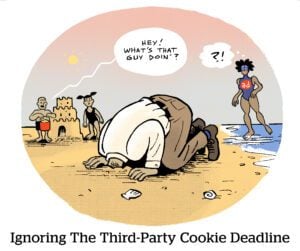
Yes, Google pushed back the deadline twice. But barring action by the UK’s competition regulator, which has oversight over Google’s rollout of the Privacy Sandbox, third-party cookies in Chrome are dunzo.

What do data privacy and protection have in common with prostate health? More than you’d think. Prevention is the best cure.

Meet the Privacy Implementation & Accountability Task Force, a new joint effort by the IAB and IAB Tech Lab to develop standards and best practices that strike the tricky balance between consumer privacy and preserving addressability.

In 1964, Supreme Court Justice Potter Stewart famously defined pornography by not defining it: “I know it when I see it.” I’d argue that, at least from the consumer’s perspective, the opposite statement applies to contextual advertising. Because, online at least, the definition can be … rather fungible. As the Federal Trade Commission noted in […]

Collecting consent is a far more nuanced process than just getting someone to opt in. It also matters how you ask for it.

Even companies that make good-faith efforts to comply with data protection laws can unwittingly end up with front-row seats to the privacy theater.

European regulators are losing their patience with companies that attempt to use legitimate interest as their legal basis for processing personal data. Meta is learning this the hard way.

Something ostensibly “good” (consumer privacy protection) could also be an antitrust violation. Weird world. Which is why data protection authorities and their antitrust counterparts must collaborate and compare notes.

Roughly three years after the Schrems II case invalidated Privacy Shield overnight – and with it the legal basis for data transfers between Europe and the US – the European Commission adopted its “adequacy decision” for the EU-US Data Privacy Framework.

There are certain privacy-related phrases companies use when they’re talking about their products that should make your antennae twitch. If you hear them, it’s a signal to ask questions.

There’s been such a deluge of data privacy-related news over the past few weeks – from the TikTok ban in Montana to the $1.3 billion GDPR fine against Meta in Europe – I hardly know what to focus on.

The FTC is proposing a series of modifications to its 2020 consent decree with Facebook (from the pre-Meta days) that would have a tremendous impact on how the company does business – including a “blanket prohibition” against monetizing the data of children under 18 across all of Meta’s services.

Apple’s ATT spurred Meta to shore up its ad platform and make it less vulnerable to future changes on other platforms – but that doesn’t change the fact that regulators remain ready and raring to crack down.
Although it’s not legally required, many websites in the US have started using cookie banners in a misguided attempt to protect themselves from lawyers who smell blood in the water.

Regulators have made it clear that they have their eye on how data flows between first parties and their partners – and that first parties are responsible for what happens when the data they collect is shared with others.

People do seem rather willing to give up a lot of information about themselves – including biometric data – without considering the consequences. Consider the case of Panera Bread and its loyalty program.
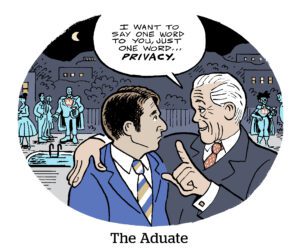
Sharing enough detail without being overwhelming is a difficult balance to strike, and there’s no perfect answer. But one thing is for certain: Privacy platitudes are for hacks or for those with something to hide.
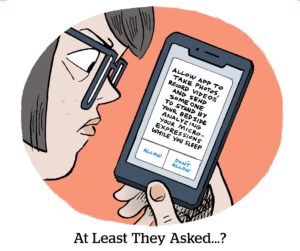
In a world where people casually toss around the term “surveillance advertising” and Congress is pushing for a national privacy law, has the clock run out on self-regulation?

So, I tried using AdChoices to opt out of seeing an ad. But the experience didn’t go very well, to say the least.

I’ve heard people say that there’s a Simpsons reference for every occasion. I posit that the same could be said of “South Park.” There’s an episode from 2011 that perfectly encapsulates the debate about notice and choice.
We’re living in a new reality, and the ad industry has to accept some home truths about itself if it wants to evolve.

It’s a resolution of mine to start using the word “people” more often than the word “consumer.” People are more than just what they consume.